Culture

African Oral Traditions Are Adapting, Not Dying

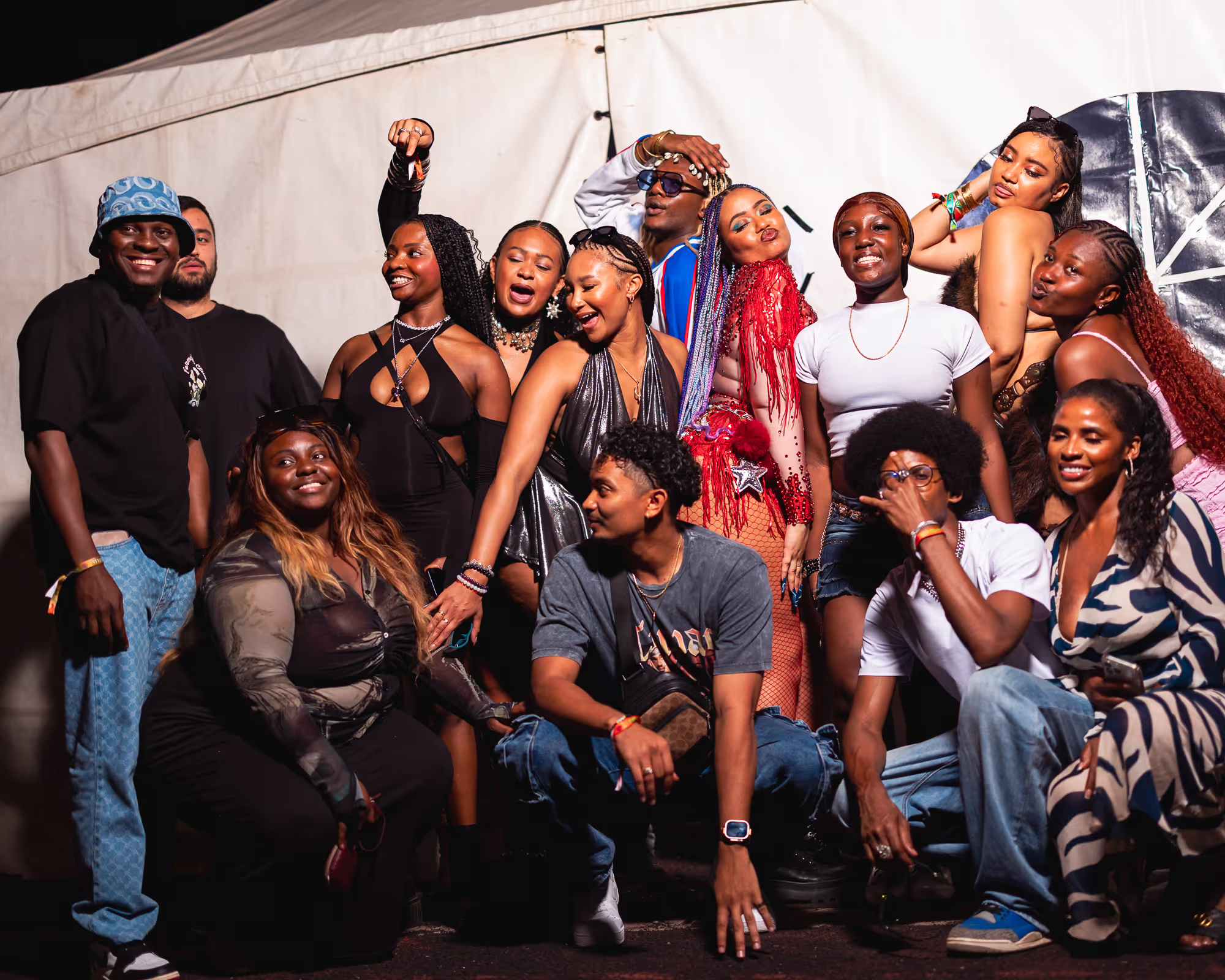
Every two years, the World Folklore Conference convenes in a different global city, and this year it came to Nairobi. It was the first time in the event's 40-year history that an African city had hosted, and the symbolism was not lost on anyone in attendance.

Folklore conference Nairobi
Nairobi hosted the World Folklore Conference for the first time in the event's four-decade history.
What the Conference Actually Is

The World Folklore Conference is not primarily an academic event, though academics attend in significant numbers. It is more accurately a gathering of practitioners — people who tell stories, perform oral traditions, document disappearing languages, animate cultural memory. The conversations that happen in the hallways matter as much as the formal presentations. The point is contact: traditions meeting each other, practitioners borrowing and being changed by what they encounter.

What the African Delegations Brought

Over four days, storytellers, oral historians, linguists, and cultural practitioners from 52 countries gathered. The African delegations were, by any measure, the most diverse and arguably the most vital in the room. Griot traditions from West Africa, epic oral poetry from the Horn, call-and-response performance from the Great Lakes region, praise singers and satirists and teachers using story as pedagogy — the range was extraordinary.

Storytelling performance
Oral tradition practitioners from across the continent demonstrated forms that have been transmitted across hundreds of generations.
Adapting Without Losing

What emerged from the conversations was a picture of African oral tradition not as something fading but as something actively adapting — finding new containers in podcasts, in spoken word performance, in animation — without losing the essential quality that made it powerful in the first place. The essential quality is presence. The relationship between teller and listener that creates the conditions for meaning. That relationship is possible in new forms; it requires only that the new form be designed to enable it.

"Our stories didn't survive because we kept them the same. They survived because we knew when to change the vessel."
The Oldest Stories Finding New Mouths

The oldest stories are finding new mouths. The griot tradition is appearing in hip-hop verses. The praise singer is becoming the hype person who also has a podcast. The epic oral poem is being adapted into episodic audio drama with production values that attract listeners who have never heard a griot but are finding their way to something adjacent to it. This is not dilution. This is transmission. It looks different every generation. That's the point.

Culture
Culture

African Oral Traditions Are Adapting, Not Dying

Every two years, the World Folklore Conference convenes in a different global city, and this year it came to Nairobi. It was the first time in the event's 40-year history that an African city had hosted, and the symbolism was not lost on anyone in attendance.

Folklore conference Nairobi
Nairobi hosted the World Folklore Conference for the first time in the event's four-decade history.
What the Conference Actually Is

The World Folklore Conference is not primarily an academic event, though academics attend in significant numbers. It is more accurately a gathering of practitioners — people who tell stories, perform oral traditions, document disappearing languages, animate cultural memory. The conversations that happen in the hallways matter as much as the formal presentations. The point is contact: traditions meeting each other, practitioners borrowing and being changed by what they encounter.

What the African Delegations Brought

Over four days, storytellers, oral historians, linguists, and cultural practitioners from 52 countries gathered. The African delegations were, by any measure, the most diverse and arguably the most vital in the room. Griot traditions from West Africa, epic oral poetry from the Horn, call-and-response performance from the Great Lakes region, praise singers and satirists and teachers using story as pedagogy — the range was extraordinary.

Storytelling performance
Oral tradition practitioners from across the continent demonstrated forms that have been transmitted across hundreds of generations.
Adapting Without Losing

What emerged from the conversations was a picture of African oral tradition not as something fading but as something actively adapting — finding new containers in podcasts, in spoken word performance, in animation — without losing the essential quality that made it powerful in the first place. The essential quality is presence. The relationship between teller and listener that creates the conditions for meaning. That relationship is possible in new forms; it requires only that the new form be designed to enable it.

"Our stories didn't survive because we kept them the same. They survived because we knew when to change the vessel."
The Oldest Stories Finding New Mouths

The oldest stories are finding new mouths. The griot tradition is appearing in hip-hop verses. The praise singer is becoming the hype person who also has a podcast. The epic oral poem is being adapted into episodic audio drama with production values that attract listeners who have never heard a griot but are finding their way to something adjacent to it. This is not dilution. This is transmission. It looks different every generation. That's the point.

The client came to the project with a website that had grown organically over time. New pages were added as needs appeared, sections were duplicated inconsistently, and messaging became fragmented.

The challenge

As the website grew, maintaining consistency became increasingly challenging. Different pages followed different layout patterns, spacing varied across sections, and typography lost its hierarchy. Important messages were often repeated or buried, making it harder for visitors to quickly understand the offering.

Internally, the team struggled to update the site efficiently. Adding new pages required design decisions each time, slowing down iteration and increasing the risk of inconsistency. The existing setup no longer supported the pace or scale of the organization.

The approach

The solution began with a shift in mindset — from page-by-page design to system-first thinking. Truebase was used as the structural framework to redefine how content should be organized, presented, and scaled.

Core page types were identified first, followed by a clear hierarchy of content elements. Layouts were built using a consistent grid and spacing system, while typography was simplified into a scalable hierarchy that could accommodate varying content lengths. Every decision prioritized clarity and reuse.

The implementation

The website was rebuilt using modular sections that could be reused across multiple pages without visual drift. Each section followed predefined spacing and alignment rules, ensuring consistency regardless of where it appeared.

Content was restructured to highlight key information earlier and reduce unnecessary repetition. Dedicated layouts were introduced for case studies, metrics, and supporting content, improving readability and flow. The CMS was organized to support ongoing updates, allowing the team to manage content without breaking the underlying system.

After launch, the impact was immediately noticeable. The team was able to create and update pages faster, without needing design adjustments for each new piece of content. The website felt calmer, more predictable, and easier to navigate.

From a visitor perspective, the clearer structure reduced friction. Users could understand the offering more quickly, with less scrolling and fewer explanations required. The website began functioning as a reliable communication tool rather than a static presentation.

48%
Reduction in time required publish pages
32%
Increase in engagement

Heading 1

Heading 2

Heading 3

Heading 4

Heading 5
Heading 6

Lorem ipsum dolor sit amet, consectetur adipiscing elit, sed do eiusmod tempor incididunt ut labore et dolore magna aliqua. Ut enim ad minim veniam, quis nostrud exercitation ullamco laboris nisi ut aliquip ex ea commodo consequat. Duis aute irure dolor in reprehenderit in voluptate velit esse cillum dolore eu fugiat nulla pariatur.

Block quote

Ordered list

  1. Item 1
  2. Item 2
  3. Item 3

Unordered list

  • Item A
  • Item B
  • Item C

Text link

Bold text

Emphasis

Superscript

Subscript