Entertainment

The African Stand-Up Comedy Boom Nobody Saw Coming

The African stand-up comedy circuit has always existed. Comedians in Lagos, Nairobi, Accra, and Johannesburg have been filling clubs and theaters for decades. What is new is the infrastructure: the recording technology cheap enough for a single comedian to produce a special, the platforms willing to host it, and the diasporic audiences hungry enough to watch it.

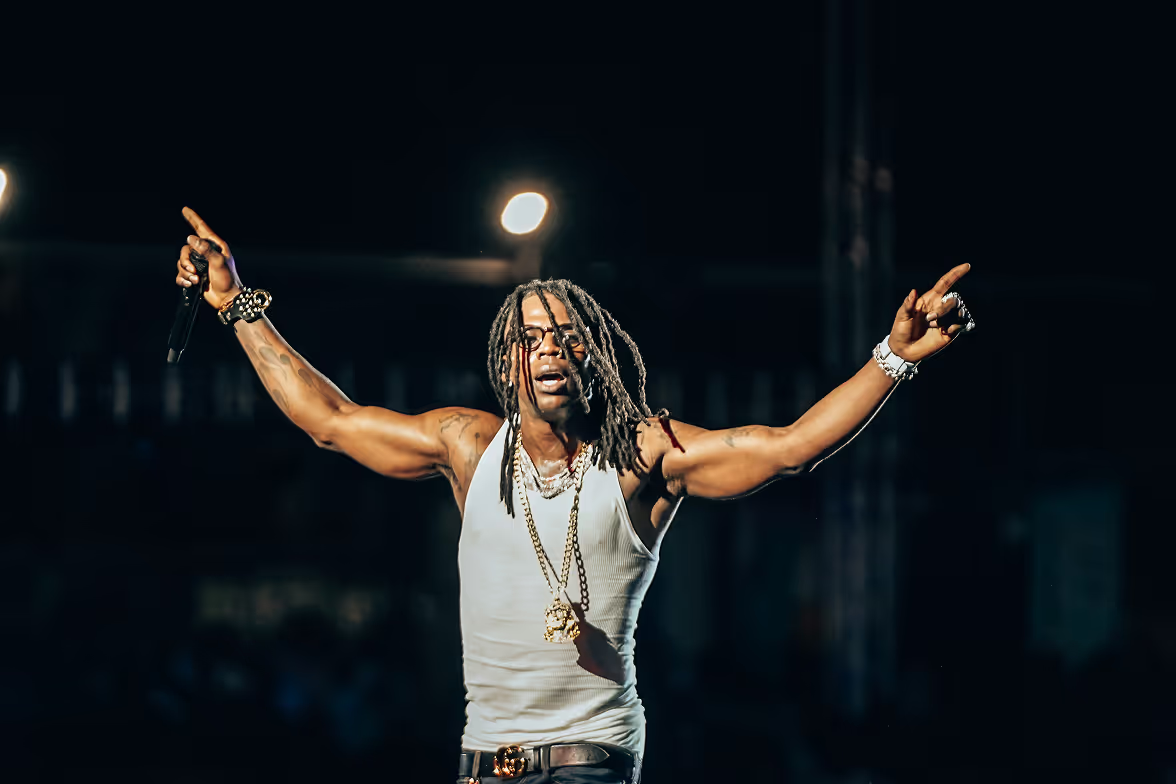
Stand-up comedy Lagos
Lagos's comedy clubs have been producing world-class stand-up for decades. The world is only now paying attention.
What Infrastructure Actually Enables

The recording and distribution infrastructure matters more than it might appear. Before affordable production and platform distribution, a comedian's audience was bounded by geography. The person funny enough to fill the Eko Hotel in Lagos had no way to reach the Nigerians in London or Houston who would have found them equally funny. Now they do. The audience didn't grow because the comedy got better. The comedy was always this good. The audience grew because the infrastructure finally caught up.

Specific and Universal at Once

The results have been striking. Several African comedians who were virtually unknown outside their home cities two years ago now have audiences in the tens of millions online. Their humor is often untranslatable in the best possible sense — built on cultural specificity, on the particular absurdities of life in African cities, on references that reward the audience that gets them. And yet non-African audiences are finding their way in too, discovering that specificity and universality are not opposites.

Comedy special production
Independent production of comedy specials has enabled African comedians to own their work and build direct audience relationships.
The Live Circuit Growing

The online numbers are translating to live audiences. African comedians are selling out rooms in London, in New York, in Toronto, in Amsterdam. The diaspora audiences who found them online are buying tickets. The non-diaspora audiences who found them through algorithm recommendation are buying tickets too. The comedy tour as a viable international business model, historically inaccessible to African performers, is becoming real.

"We were always this funny. We just didn't have the mic." — Lagos-based comedian
Nobody Saw It Coming. They Should Have.

The African stand-up comedy boom nobody saw coming was, in retrospect, completely predictable. You had extraordinary talent, a massive and underserved diaspora audience, platforms desperate for diverse content, and production costs dropping to a point where independence was viable. The boom was not a surprise. It was an inevitability waiting for the conditions to align. The conditions aligned.
Entertainment
Entertainment

The African Stand-Up Comedy Boom Nobody Saw Coming

The African stand-up comedy circuit has always existed. Comedians in Lagos, Nairobi, Accra, and Johannesburg have been filling clubs and theaters for decades. What is new is the infrastructure: the recording technology cheap enough for a single comedian to produce a special, the platforms willing to host it, and the diasporic audiences hungry enough to watch it.

Stand-up comedy Lagos
Lagos's comedy clubs have been producing world-class stand-up for decades. The world is only now paying attention.
What Infrastructure Actually Enables

The recording and distribution infrastructure matters more than it might appear. Before affordable production and platform distribution, a comedian's audience was bounded by geography. The person funny enough to fill the Eko Hotel in Lagos had no way to reach the Nigerians in London or Houston who would have found them equally funny. Now they do. The audience didn't grow because the comedy got better. The comedy was always this good. The audience grew because the infrastructure finally caught up.

Specific and Universal at Once

The results have been striking. Several African comedians who were virtually unknown outside their home cities two years ago now have audiences in the tens of millions online. Their humor is often untranslatable in the best possible sense — built on cultural specificity, on the particular absurdities of life in African cities, on references that reward the audience that gets them. And yet non-African audiences are finding their way in too, discovering that specificity and universality are not opposites.

Comedy special production
Independent production of comedy specials has enabled African comedians to own their work and build direct audience relationships.
The Live Circuit Growing

The online numbers are translating to live audiences. African comedians are selling out rooms in London, in New York, in Toronto, in Amsterdam. The diaspora audiences who found them online are buying tickets. The non-diaspora audiences who found them through algorithm recommendation are buying tickets too. The comedy tour as a viable international business model, historically inaccessible to African performers, is becoming real.

"We were always this funny. We just didn't have the mic." — Lagos-based comedian
Nobody Saw It Coming. They Should Have.

The African stand-up comedy boom nobody saw coming was, in retrospect, completely predictable. You had extraordinary talent, a massive and underserved diaspora audience, platforms desperate for diverse content, and production costs dropping to a point where independence was viable. The boom was not a surprise. It was an inevitability waiting for the conditions to align. The conditions aligned.

The client came to the project with a website that had grown organically over time. New pages were added as needs appeared, sections were duplicated inconsistently, and messaging became fragmented.

The challenge

As the website grew, maintaining consistency became increasingly challenging. Different pages followed different layout patterns, spacing varied across sections, and typography lost its hierarchy. Important messages were often repeated or buried, making it harder for visitors to quickly understand the offering.

Internally, the team struggled to update the site efficiently. Adding new pages required design decisions each time, slowing down iteration and increasing the risk of inconsistency. The existing setup no longer supported the pace or scale of the organization.

The approach

The solution began with a shift in mindset — from page-by-page design to system-first thinking. Truebase was used as the structural framework to redefine how content should be organized, presented, and scaled.

Core page types were identified first, followed by a clear hierarchy of content elements. Layouts were built using a consistent grid and spacing system, while typography was simplified into a scalable hierarchy that could accommodate varying content lengths. Every decision prioritized clarity and reuse.

The implementation

The website was rebuilt using modular sections that could be reused across multiple pages without visual drift. Each section followed predefined spacing and alignment rules, ensuring consistency regardless of where it appeared.

Content was restructured to highlight key information earlier and reduce unnecessary repetition. Dedicated layouts were introduced for case studies, metrics, and supporting content, improving readability and flow. The CMS was organized to support ongoing updates, allowing the team to manage content without breaking the underlying system.

After launch, the impact was immediately noticeable. The team was able to create and update pages faster, without needing design adjustments for each new piece of content. The website felt calmer, more predictable, and easier to navigate.

From a visitor perspective, the clearer structure reduced friction. Users could understand the offering more quickly, with less scrolling and fewer explanations required. The website began functioning as a reliable communication tool rather than a static presentation.

48%
Reduction in time required publish pages
32%
Increase in engagement

Heading 1

Heading 2

Heading 3

Heading 4

Heading 5
Heading 6

Lorem ipsum dolor sit amet, consectetur adipiscing elit, sed do eiusmod tempor incididunt ut labore et dolore magna aliqua. Ut enim ad minim veniam, quis nostrud exercitation ullamco laboris nisi ut aliquip ex ea commodo consequat. Duis aute irure dolor in reprehenderit in voluptate velit esse cillum dolore eu fugiat nulla pariatur.

Block quote

Ordered list

  1. Item 1
  2. Item 2
  3. Item 3

Unordered list

  • Item A
  • Item B
  • Item C

Text link

Bold text

Emphasis

Superscript

Subscript