Music

Afropolis Festival 2026: A Review Worth Reading

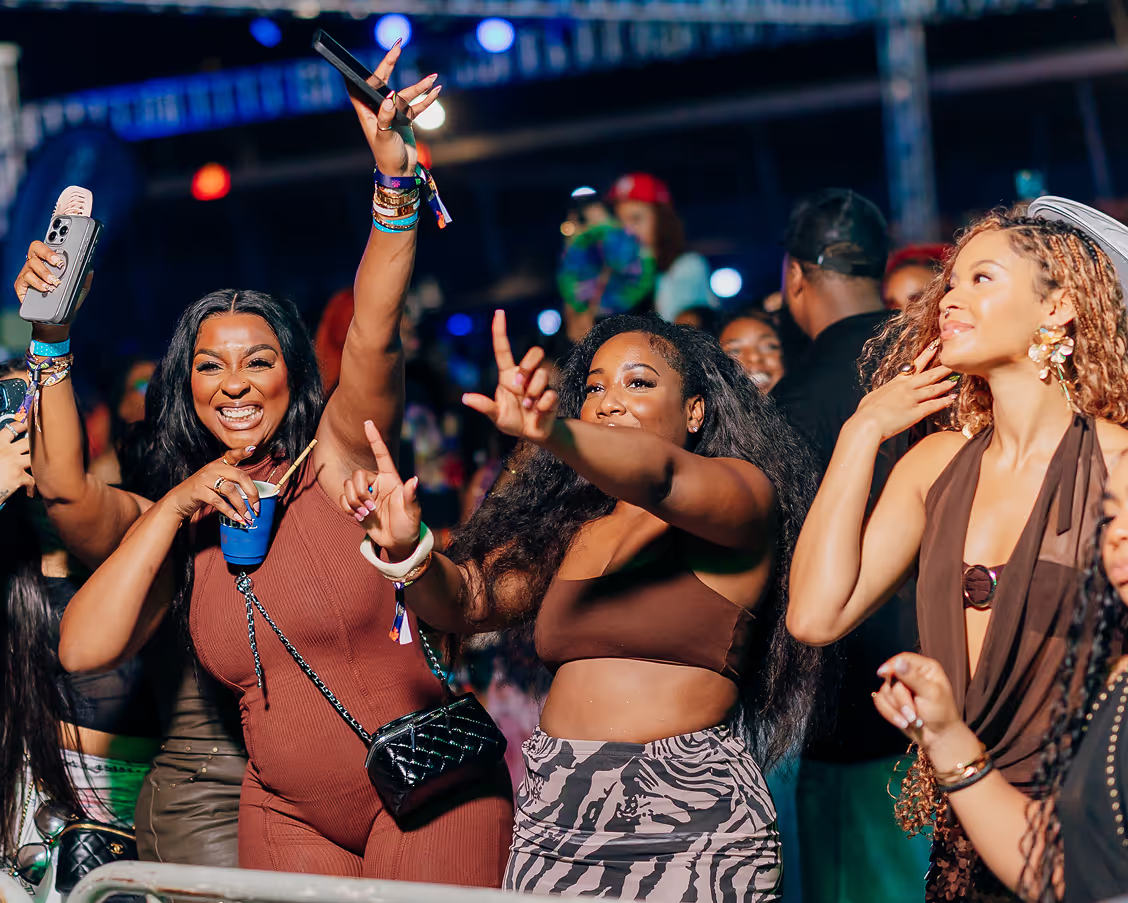
By the end of day one, the conversation had already shifted. You could feel it in the crowd at the main stage — the way people talked about what they'd just witnessed, not as a concert experience but as something closer to a cultural event. That's what Afropolis does at its best: it makes the stakes feel real.

Afropolis main stage
The main stage at Afropolis 2026 drew record single-day attendance on both Friday and Saturday.
The Lineup, Honestly Assessed

This year's lineup was the most ambitious yet. Established acts delivered exactly what was expected of them — which, when you're talking about artists of this caliber, is still extraordinary. The headliners understood the room and played to it without condescension. The middle of the bill, where festivals usually go soft, was instead where Afropolis 2026 showed its curation muscle: four acts in a row on the second stage that represented four completely different directions the music is moving simultaneously.

The Moments That Mattered

A 23-year-old singer from Kumasi played to a packed tent at 2pm on a Saturday and somehow made it feel like the most important set of the weekend. A Tanzanian producer closed out the electronic stage at midnight to a crowd that didn't want to leave. A spoken word performance between two sets on Sunday afternoon stopped people mid-walk and held them for eighteen minutes. These are the moments that festivals exist to produce and rarely do.

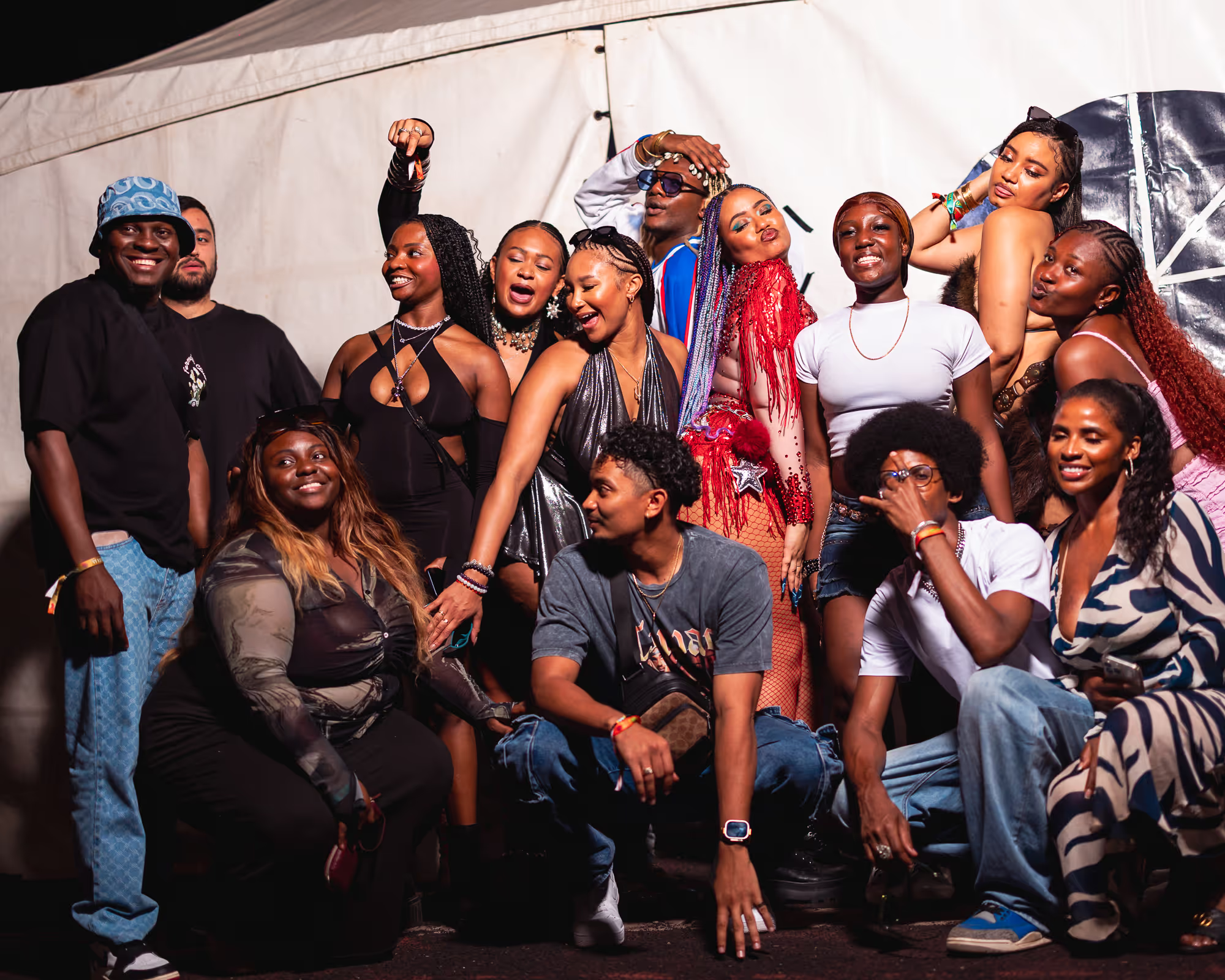
Festival crowd at sunset
The weekend's most talked-about moment happened not on the main stage but in a tent at 2pm on Saturday.
The Conversations Off Stage

What Afropolis does increasingly well is treat the festival as a forum as well as a concert. The panel discussions, the industry meetings, the informal conversations happening in the food village between sets — all of it contributes to a sense that something is being built here, not just consumed. That ambition makes it different from most festivals its size.

"The music is the reason we come. The conversation is the reason we come back."
What It Confirmed

Afropolis 2026 confirmed what many of us already suspected: the center of gravity in global music has moved, and it's not moving back. The audience knew it. The artists knew it. The question for next year is what you do with that knowledge when you're planning the lineup. We're looking forward to finding out.
By the end of day one, the conversation had already shifted. You could feel it in the crowd at the main stage — the way people talked about what they'd just witnessed, not as a concert experience but as something closer to a cultural event. That's what Afropolis does at its best: it makes the stakes feel real.

Afropolis main stage
The main stage at Afropolis 2026 drew record single-day attendance on both Friday and Saturday.
The Lineup, Honestly Assessed

This year's lineup was the most ambitious yet. Established acts delivered exactly what was expected of them — which, when you're talking about artists of this caliber, is still extraordinary. The headliners understood the room and played to it without condescension. The middle of the bill, where festivals usually go soft, was instead where Afropolis 2026 showed its curation muscle: four acts in a row on the second stage that represented four completely different directions the music is moving simultaneously.

The Moments That Mattered

A 23-year-old singer from Kumasi played to a packed tent at 2pm on a Saturday and somehow made it feel like the most important set of the weekend. A Tanzanian producer closed out the electronic stage at midnight to a crowd that didn't want to leave. A spoken word performance between two sets on Sunday afternoon stopped people mid-walk and held them for eighteen minutes. These are the moments that festivals exist to produce and rarely do.

Festival crowd at sunset
The weekend's most talked-about moment happened not on the main stage but in a tent at 2pm on Saturday.
The Conversations Off Stage

What Afropolis does increasingly well is treat the festival as a forum as well as a concert. The panel discussions, the industry meetings, the informal conversations happening in the food village between sets — all of it contributes to a sense that something is being built here, not just consumed. That ambition makes it different from most festivals its size.

"The music is the reason we come. The conversation is the reason we come back."
What It Confirmed

Afropolis 2026 confirmed what many of us already suspected: the center of gravity in global music has moved, and it's not moving back. The audience knew it. The artists knew it. The question for next year is what you do with that knowledge when you're planning the lineup. We're looking forward to finding out.

The client came to the project with a website that had grown organically over time. New pages were added as needs appeared, sections were duplicated inconsistently, and messaging became fragmented.

The challenge

As the website grew, maintaining consistency became increasingly challenging. Different pages followed different layout patterns, spacing varied across sections, and typography lost its hierarchy. Important messages were often repeated or buried, making it harder for visitors to quickly understand the offering.

Internally, the team struggled to update the site efficiently. Adding new pages required design decisions each time, slowing down iteration and increasing the risk of inconsistency. The existing setup no longer supported the pace or scale of the organization.

The approach

The solution began with a shift in mindset — from page-by-page design to system-first thinking. Truebase was used as the structural framework to redefine how content should be organized, presented, and scaled.

Core page types were identified first, followed by a clear hierarchy of content elements. Layouts were built using a consistent grid and spacing system, while typography was simplified into a scalable hierarchy that could accommodate varying content lengths. Every decision prioritized clarity and reuse.

The implementation

The website was rebuilt using modular sections that could be reused across multiple pages without visual drift. Each section followed predefined spacing and alignment rules, ensuring consistency regardless of where it appeared.

Content was restructured to highlight key information earlier and reduce unnecessary repetition. Dedicated layouts were introduced for case studies, metrics, and supporting content, improving readability and flow. The CMS was organized to support ongoing updates, allowing the team to manage content without breaking the underlying system.

After launch, the impact was immediately noticeable. The team was able to create and update pages faster, without needing design adjustments for each new piece of content. The website felt calmer, more predictable, and easier to navigate.

From a visitor perspective, the clearer structure reduced friction. Users could understand the offering more quickly, with less scrolling and fewer explanations required. The website began functioning as a reliable communication tool rather than a static presentation.

48%
Reduction in time required publish pages
32%
Increase in engagement

Heading 1

Heading 2

Heading 3

Heading 4

Heading 5
Heading 6

Lorem ipsum dolor sit amet, consectetur adipiscing elit, sed do eiusmod tempor incididunt ut labore et dolore magna aliqua. Ut enim ad minim veniam, quis nostrud exercitation ullamco laboris nisi ut aliquip ex ea commodo consequat. Duis aute irure dolor in reprehenderit in voluptate velit esse cillum dolore eu fugiat nulla pariatur.

Block quote

Ordered list

  1. Item 1
  2. Item 2
  3. Item 3

Unordered list

  • Item A
  • Item B
  • Item C

Text link

Bold text

Emphasis

Superscript

Subscript