Ousmane Sembène was almost forty when he decided to become a filmmaker. He had already lived several lives. He had been a fisherman’s son in Senegal, a soldier, a dockworker in Marseille and a novelist whose books were praised in Paris. Then he noticed a problem. The people he was writing about could not read his novels. They were written in French, and most of his country did not read French.
So he went to Moscow, learned to use a camera, and came home. Film, he said, was a night school. You could show it on a wall in a village, and everyone would understand.
That decision is the beginning of a tradition. Across the continent, for sixty years, filmmakers have picked up the camera for the same reason Sembène did. Not to entertain an audience, but to arm one. Here are eight films that show how.
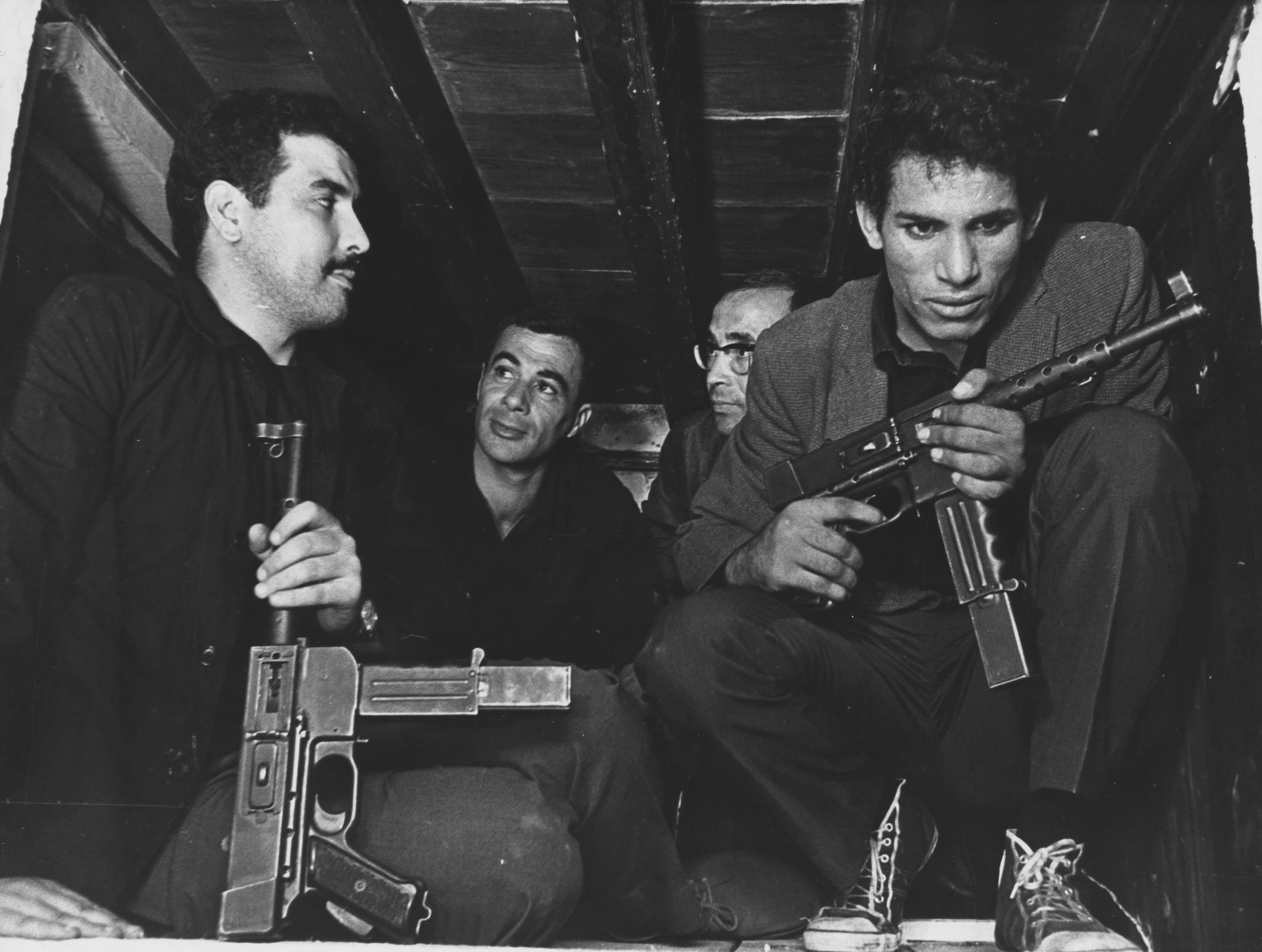
The Battle of Algiers (1966, Algeria), directed by Gillo Pontecorvo. Shot on the real streets of the Casbah, with people who had lived through the war, it recreates Algeria’s fight for independence from France so precisely that it has been studied by revolutionaries and by the armies sent to stop them.
Black Girl (1966, Senegal), directed by Ousmane Sembène. A young Senegalese woman follows her employers to France and finds a prison where she expected a future. It was the first feature from sub-Saharan Africa to win international recognition, and it remains a quiet, devastating study of what independence left unfinished.
Ceddo (1977, Senegal), directed by Ousmane Sembène. A story of people who refuse both forced conversion and the slave trade. Senegal’s own government banned it, officially over the spelling of the title. The real offence was the argument.
Mapantsula (1988, South Africa), directed by Oliver Schmitz. A small-time thief is pulled into the struggle against apartheid whether he likes it or not. The filmmakers got it past the censors by presenting it as a simple gangster picture. It shows the system from street level, which is why it has lasted.
Amandla! A Revolution in Four Part Harmony (2002, South Africa), directed by Lee Hirsch. The fight against apartheid told through the songs that carried it. Music here is not a soundtrack. It is strategy, morale and memory.
The Square (2013, Egypt), directed by Jehane Noujaim. Filmed inside Tahrir Square as the revolution unfolded, with no idea how the story would end. It is one of the clearest records we have of what modern protest feels like from within.
This Is Not a Burial, It’s a Resurrection (2019, Lesotho), directed by Lemohang Jeremiah Mosese. An elderly widow leads her village against a dam that will flood the graves of their ancestors. Slow, strange and beautiful, it finds resistance in grief and in land.
Mandela: Long Walk to Freedom (2013), directed by Justin Chadwick. Idris Elba carries the story from the young lawyer to the prisoner to the president. It is the most familiar film on this list, and a good door into the rest.
Put side by side, these films span half a century and the length of a continent. What unites them is a belief about what a camera is for. In much of the world, cinema grew up as an escape from real life. In Africa, again and again, it has been used as a way back into it.
Sembène understood this before anyone. A film can be banned, as his was. It can be censored, smuggled, shown on a sheet in a courtyard. But once people have seen themselves on a screen, as the heroes of their own story, something has changed that cannot be changed back.
That is the night school. It is still in session.
The client came to the project with a website that had grown organically over time. New pages were added as needs appeared, sections were duplicated inconsistently, and messaging became fragmented.
The challenge
As the website grew, maintaining consistency became increasingly challenging. Different pages followed different layout patterns, spacing varied across sections, and typography lost its hierarchy. Important messages were often repeated or buried, making it harder for visitors to quickly understand the offering.
Internally, the team struggled to update the site efficiently. Adding new pages required design decisions each time, slowing down iteration and increasing the risk of inconsistency. The existing setup no longer supported the pace or scale of the organization.
The approach
The solution began with a shift in mindset — from page-by-page design to system-first thinking. Truebase was used as the structural framework to redefine how content should be organized, presented, and scaled.
Core page types were identified first, followed by a clear hierarchy of content elements. Layouts were built using a consistent grid and spacing system, while typography was simplified into a scalable hierarchy that could accommodate varying content lengths. Every decision prioritized clarity and reuse.
The implementation
The website was rebuilt using modular sections that could be reused across multiple pages without visual drift. Each section followed predefined spacing and alignment rules, ensuring consistency regardless of where it appeared.
Content was restructured to highlight key information earlier and reduce unnecessary repetition. Dedicated layouts were introduced for case studies, metrics, and supporting content, improving readability and flow. The CMS was organized to support ongoing updates, allowing the team to manage content without breaking the underlying system.


After launch, the impact was immediately noticeable. The team was able to create and update pages faster, without needing design adjustments for each new piece of content. The website felt calmer, more predictable, and easier to navigate.
From a visitor perspective, the clearer structure reduced friction. Users could understand the offering more quickly, with less scrolling and fewer explanations required. The website began functioning as a reliable communication tool rather than a static presentation.