Fashion

Lagos Fashion Week 2026 Was a Statement

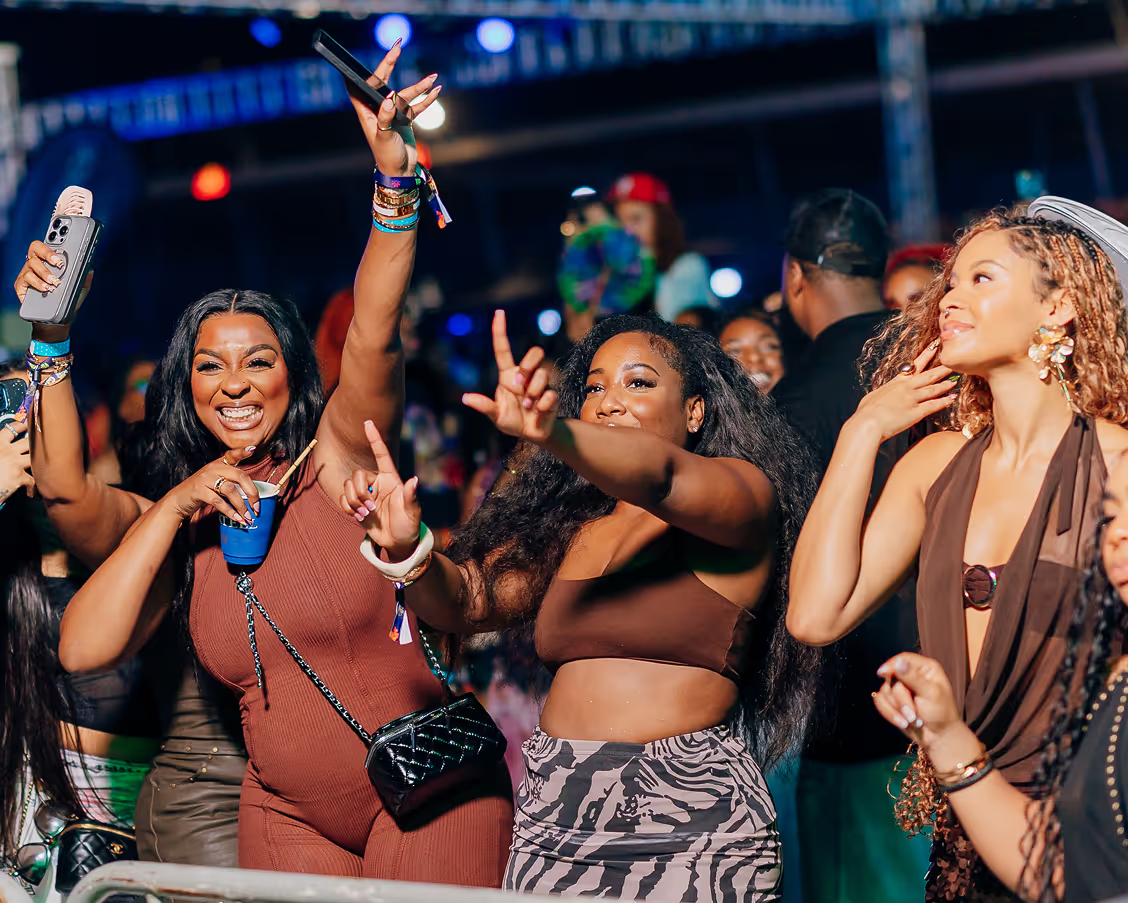
Lagos Fashion Week has always been a statement. What began as a regional showcase has, over the past decade, become one of the most watched events on the global fashion calendar — not because it imitated what was happening in Paris or Milan, but precisely because it didn't.

Lagos Fashion Week runway
Lagos Fashion Week 2026 drew its largest international press contingent in the event's history.
What Made This Season Different

This season's presentations were the boldest yet. Designers worked in Ankara, aso-oke, and Kente alongside technical fabrics and unconventional silhouettes, producing collections that felt rooted and forward simultaneously. The clothes did not apologize for their references. They insisted on them. Several collections were explicitly constructed around specific Yoruba or Igbo textile traditions, with accompanying notes that provided cultural context to an international press corps that needed it.

The Business Behind the Runway

International buyers and press, present in record numbers, responded accordingly. Pre-orders for several collections were reportedly the highest in the event's history. Two Lagos-based designers announced partnerships with European retailers in the weeks following the show. A third signed a distribution deal that will put her work in physical retail for the first time outside Nigeria. The fashion is making the business case for itself.

Designer backstage
Several designers used the post-show period to announce international retail partnerships secured during the event.
What the Critics Said

Critical coverage from the international fashion press was, for the first time, substantive rather than enthusiastic. The difference matters. Enthusiastic coverage treats African fashion as interesting and novel. Substantive coverage engages with specific collections, specific designers, specific choices. It is the kind of coverage that builds careers rather than just narratives. This season earned it.

"Lagos is no longer playing catch-up. It's setting the pace." — International fashion editor, post-show
What Comes Next

Lagos Fashion Week is no longer building credibility. It has it. The question now is what it does with it — how it develops its infrastructure, supports emerging designers, engages the African retail market that has sometimes been secondary to the international press ambition, and maintains the editorial confidence that made 2026 the best edition yet.
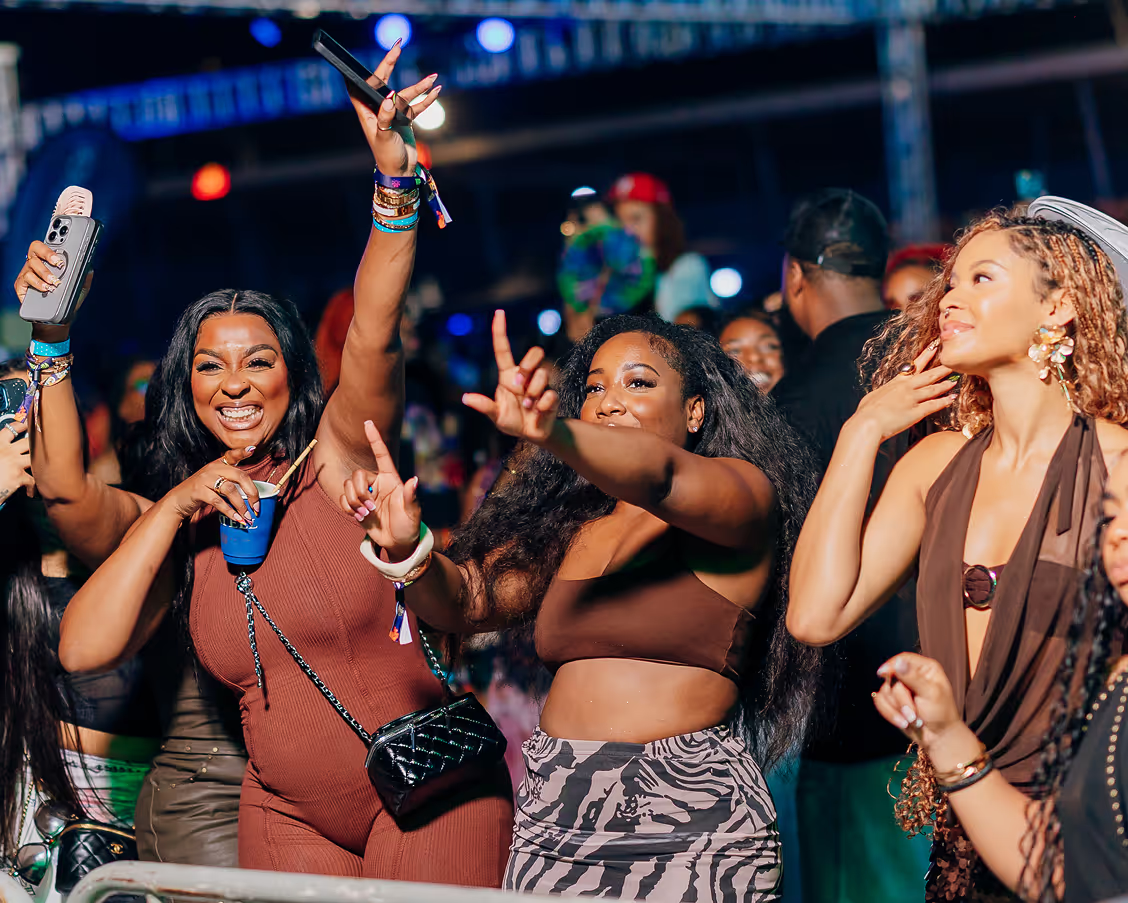
Lagos Fashion Week has always been a statement. What began as a regional showcase has, over the past decade, become one of the most watched events on the global fashion calendar — not because it imitated what was happening in Paris or Milan, but precisely because it didn't.

Lagos Fashion Week runway
Lagos Fashion Week 2026 drew its largest international press contingent in the event's history.
What Made This Season Different

This season's presentations were the boldest yet. Designers worked in Ankara, aso-oke, and Kente alongside technical fabrics and unconventional silhouettes, producing collections that felt rooted and forward simultaneously. The clothes did not apologize for their references. They insisted on them. Several collections were explicitly constructed around specific Yoruba or Igbo textile traditions, with accompanying notes that provided cultural context to an international press corps that needed it.

The Business Behind the Runway

International buyers and press, present in record numbers, responded accordingly. Pre-orders for several collections were reportedly the highest in the event's history. Two Lagos-based designers announced partnerships with European retailers in the weeks following the show. A third signed a distribution deal that will put her work in physical retail for the first time outside Nigeria. The fashion is making the business case for itself.

Designer backstage
Several designers used the post-show period to announce international retail partnerships secured during the event.
What the Critics Said

Critical coverage from the international fashion press was, for the first time, substantive rather than enthusiastic. The difference matters. Enthusiastic coverage treats African fashion as interesting and novel. Substantive coverage engages with specific collections, specific designers, specific choices. It is the kind of coverage that builds careers rather than just narratives. This season earned it.

"Lagos is no longer playing catch-up. It's setting the pace." — International fashion editor, post-show
What Comes Next

Lagos Fashion Week is no longer building credibility. It has it. The question now is what it does with it — how it develops its infrastructure, supports emerging designers, engages the African retail market that has sometimes been secondary to the international press ambition, and maintains the editorial confidence that made 2026 the best edition yet.

The client came to the project with a website that had grown organically over time. New pages were added as needs appeared, sections were duplicated inconsistently, and messaging became fragmented.

The challenge

As the website grew, maintaining consistency became increasingly challenging. Different pages followed different layout patterns, spacing varied across sections, and typography lost its hierarchy. Important messages were often repeated or buried, making it harder for visitors to quickly understand the offering.

Internally, the team struggled to update the site efficiently. Adding new pages required design decisions each time, slowing down iteration and increasing the risk of inconsistency. The existing setup no longer supported the pace or scale of the organization.

The approach

The solution began with a shift in mindset — from page-by-page design to system-first thinking. Truebase was used as the structural framework to redefine how content should be organized, presented, and scaled.

Core page types were identified first, followed by a clear hierarchy of content elements. Layouts were built using a consistent grid and spacing system, while typography was simplified into a scalable hierarchy that could accommodate varying content lengths. Every decision prioritized clarity and reuse.

The implementation

The website was rebuilt using modular sections that could be reused across multiple pages without visual drift. Each section followed predefined spacing and alignment rules, ensuring consistency regardless of where it appeared.

Content was restructured to highlight key information earlier and reduce unnecessary repetition. Dedicated layouts were introduced for case studies, metrics, and supporting content, improving readability and flow. The CMS was organized to support ongoing updates, allowing the team to manage content without breaking the underlying system.

After launch, the impact was immediately noticeable. The team was able to create and update pages faster, without needing design adjustments for each new piece of content. The website felt calmer, more predictable, and easier to navigate.

From a visitor perspective, the clearer structure reduced friction. Users could understand the offering more quickly, with less scrolling and fewer explanations required. The website began functioning as a reliable communication tool rather than a static presentation.

48%
Reduction in time required publish pages
32%
Increase in engagement

Heading 1

Heading 2

Heading 3

Heading 4

Heading 5
Heading 6

Lorem ipsum dolor sit amet, consectetur adipiscing elit, sed do eiusmod tempor incididunt ut labore et dolore magna aliqua. Ut enim ad minim veniam, quis nostrud exercitation ullamco laboris nisi ut aliquip ex ea commodo consequat. Duis aute irure dolor in reprehenderit in voluptate velit esse cillum dolore eu fugiat nulla pariatur.

Block quote

Ordered list

  1. Item 1
  2. Item 2
  3. Item 3

Unordered list

  • Item A
  • Item B
  • Item C

Text link

Bold text

Emphasis

Superscript

Subscript