Fashion

Lagos to London: The African Designers Dressing the World's Most Stylish People

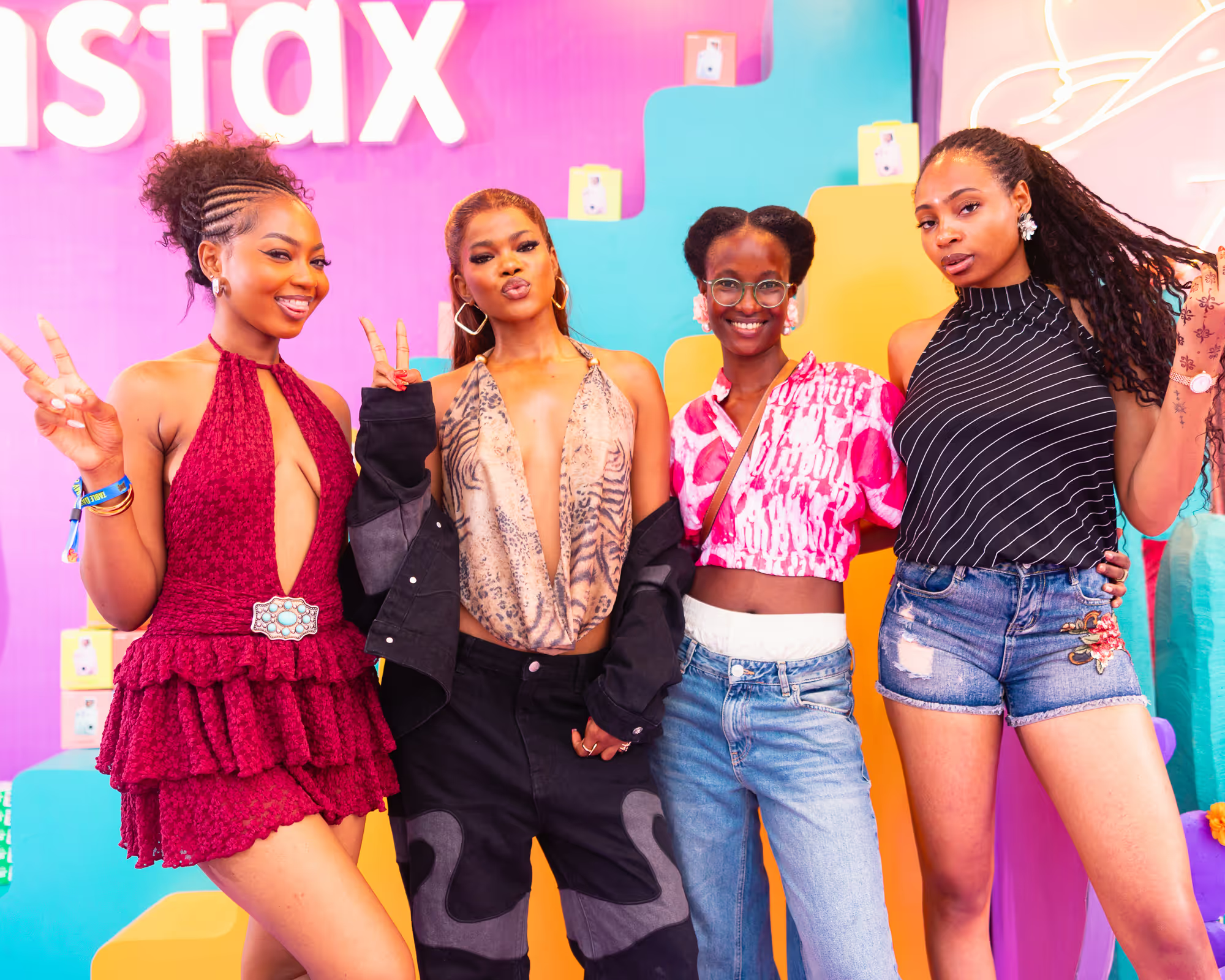
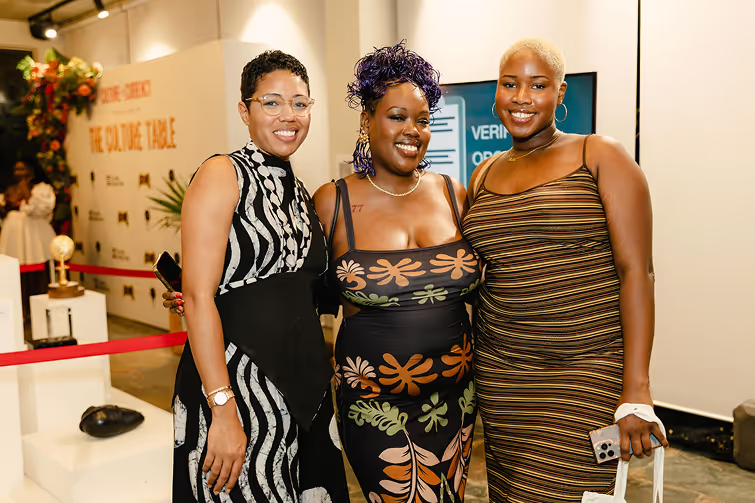
There is a list that does not exist officially but that anyone in fashion can feel taking shape — the African designers whose work is appearing in the wardrobes of the people whose wardrobes everyone else watches. Not as a diversity inclusion, not as a trend moment, but as a genuine curatorial choice.

African designer collection
The most stylish people in Lagos, London, and New York are making the same choices — gravitating toward African designers not because they're supposed to but because the work is genuinely the best thing available.
What Genuine Curatorial Choice Looks Like

A genuine curatorial choice is different from a diversity gesture in a legible way: it is repeated, it is defended with specific aesthetic reasoning, and it is not contingent on external validation. The fashion editors and stylists and cultural figures who are choosing African designers are not doing it because it is expected. They are doing it because the work is genuinely the best option available for what they are trying to achieve. That distinction is everything.

What the Designers Have in Common

The designers earning this kind of attention have something in common: they are not making African fashion for a Western gaze. They are making fashion, full stop, deeply rooted in African craft traditions and silhouettes. The work is not legible as exotic or other. It is legible as exceptional — technically sophisticated, conceptually coherent, aesthetically distinct. The world is learning to see the difference.

Lagos to London fashion
The designers making this list share a refusal to make work that explains itself to an outsider. The work assumes an informed audience and dresses it accordingly.
The Infrastructure That's Still Missing

The gap between cultural recognition and commercial infrastructure remains significant. Designers whose work appears on the most stylish people in London are often still operating without the retail infrastructure, the wholesale relationships, or the production capacity to meet the demand that recognition creates. The recognition is real and growing. The infrastructure to capitalize on it is still being built.

"Being the best-dressed person's favorite designer is wonderful. Being able to actually sell them the clothes is a different conversation."
What Dressing the World's Most Stylish People Actually Means

It is taking its time buying things from people who have always known it — but it is buying. Slowly, then all at once, the same way everything in fashion actually changes. The list is getting longer. The infrastructure is developing. The moment when African designers are not a notable subset of the global fashion conversation but simply part of it — unremarkably, as a matter of course — is closer than it has ever been.
Fashion
Fashion

Lagos to London: The African Designers Dressing the World's Most Stylish People

There is a list that does not exist officially but that anyone in fashion can feel taking shape — the African designers whose work is appearing in the wardrobes of the people whose wardrobes everyone else watches. Not as a diversity inclusion, not as a trend moment, but as a genuine curatorial choice.

African designer collection
The most stylish people in Lagos, London, and New York are making the same choices — gravitating toward African designers not because they're supposed to but because the work is genuinely the best thing available.
What Genuine Curatorial Choice Looks Like

A genuine curatorial choice is different from a diversity gesture in a legible way: it is repeated, it is defended with specific aesthetic reasoning, and it is not contingent on external validation. The fashion editors and stylists and cultural figures who are choosing African designers are not doing it because it is expected. They are doing it because the work is genuinely the best option available for what they are trying to achieve. That distinction is everything.

What the Designers Have in Common

The designers earning this kind of attention have something in common: they are not making African fashion for a Western gaze. They are making fashion, full stop, deeply rooted in African craft traditions and silhouettes. The work is not legible as exotic or other. It is legible as exceptional — technically sophisticated, conceptually coherent, aesthetically distinct. The world is learning to see the difference.

Lagos to London fashion
The designers making this list share a refusal to make work that explains itself to an outsider. The work assumes an informed audience and dresses it accordingly.
The Infrastructure That's Still Missing

The gap between cultural recognition and commercial infrastructure remains significant. Designers whose work appears on the most stylish people in London are often still operating without the retail infrastructure, the wholesale relationships, or the production capacity to meet the demand that recognition creates. The recognition is real and growing. The infrastructure to capitalize on it is still being built.

"Being the best-dressed person's favorite designer is wonderful. Being able to actually sell them the clothes is a different conversation."
What Dressing the World's Most Stylish People Actually Means

It is taking its time buying things from people who have always known it — but it is buying. Slowly, then all at once, the same way everything in fashion actually changes. The list is getting longer. The infrastructure is developing. The moment when African designers are not a notable subset of the global fashion conversation but simply part of it — unremarkably, as a matter of course — is closer than it has ever been.

The client came to the project with a website that had grown organically over time. New pages were added as needs appeared, sections were duplicated inconsistently, and messaging became fragmented.

The challenge

As the website grew, maintaining consistency became increasingly challenging. Different pages followed different layout patterns, spacing varied across sections, and typography lost its hierarchy. Important messages were often repeated or buried, making it harder for visitors to quickly understand the offering.

Internally, the team struggled to update the site efficiently. Adding new pages required design decisions each time, slowing down iteration and increasing the risk of inconsistency. The existing setup no longer supported the pace or scale of the organization.

The approach

The solution began with a shift in mindset — from page-by-page design to system-first thinking. Truebase was used as the structural framework to redefine how content should be organized, presented, and scaled.

Core page types were identified first, followed by a clear hierarchy of content elements. Layouts were built using a consistent grid and spacing system, while typography was simplified into a scalable hierarchy that could accommodate varying content lengths. Every decision prioritized clarity and reuse.

The implementation

The website was rebuilt using modular sections that could be reused across multiple pages without visual drift. Each section followed predefined spacing and alignment rules, ensuring consistency regardless of where it appeared.

Content was restructured to highlight key information earlier and reduce unnecessary repetition. Dedicated layouts were introduced for case studies, metrics, and supporting content, improving readability and flow. The CMS was organized to support ongoing updates, allowing the team to manage content without breaking the underlying system.

After launch, the impact was immediately noticeable. The team was able to create and update pages faster, without needing design adjustments for each new piece of content. The website felt calmer, more predictable, and easier to navigate.

From a visitor perspective, the clearer structure reduced friction. Users could understand the offering more quickly, with less scrolling and fewer explanations required. The website began functioning as a reliable communication tool rather than a static presentation.

48%
Reduction in time required publish pages
32%
Increase in engagement

Heading 1

Heading 2

Heading 3

Heading 4

Heading 5
Heading 6

Lorem ipsum dolor sit amet, consectetur adipiscing elit, sed do eiusmod tempor incididunt ut labore et dolore magna aliqua. Ut enim ad minim veniam, quis nostrud exercitation ullamco laboris nisi ut aliquip ex ea commodo consequat. Duis aute irure dolor in reprehenderit in voluptate velit esse cillum dolore eu fugiat nulla pariatur.

Block quote

Ordered list

  1. Item 1
  2. Item 2
  3. Item 3

Unordered list

  • Item A
  • Item B
  • Item C

Text link

Bold text

Emphasis

Superscript

Subscript