Culture

Beyond the Monolith: What It Actually Means to Be Pan-African in 2026

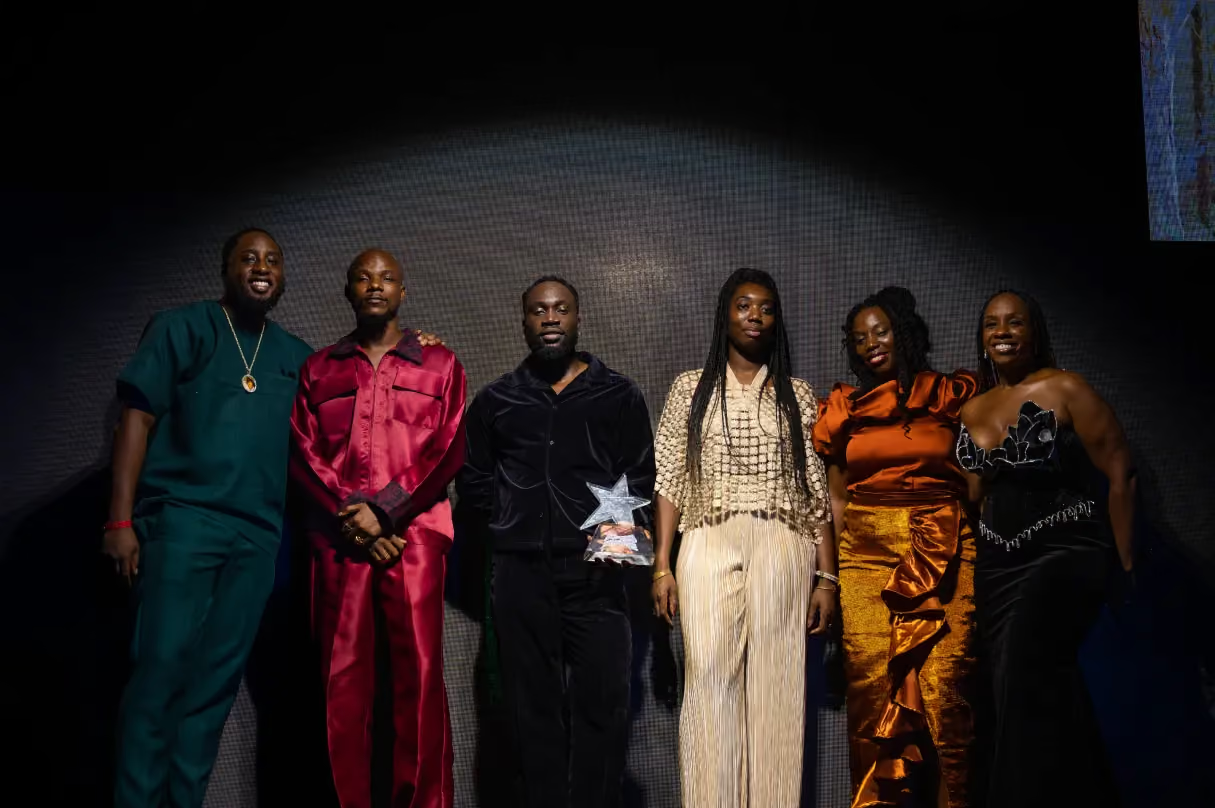
Pan-Africanism as a political ideology has a specific history — Nkrumah, Nyerere, Marcus Garvey, the Organisation of African Unity — and it is worth knowing that history before using the term. What the word means in 2026, in the context of African streetwear brands and Afrobeats playlists and diaspora Twitter, is something substantially different from what it meant at the Bandung Conference in 1955.

Pan-African movement 2026
Pan-Africanism in 2026 is as much a cultural phenomenon as a political one — and the two are not always in agreement.
The History Worth Knowing

The political Pan-Africanism of Nkrumah and Nyerere was a specific project: continental unity as a prerequisite for decolonization, economic sovereignty, and political self-determination. It had a theory of power and a theory of change. It was serious, contentious, and ultimately only partially realized. Understanding that history matters because the cultural Pan-Africanism of 2026 is in conversation with it — whether or not the people practicing it know the conversation is happening.

Dilution or Evolution?

The question is whether the difference between political and cultural Pan-Africanism represents a dilution or an evolution. The pessimistic reading: a political project with genuine stakes has been reduced to an aesthetic and a vibe, its radical implications softened into brand identity. The optimistic reading: the cultural moment is building the affective infrastructure — the sense of shared identity and shared interest — that political Pan-Africanism always needed and rarely had.

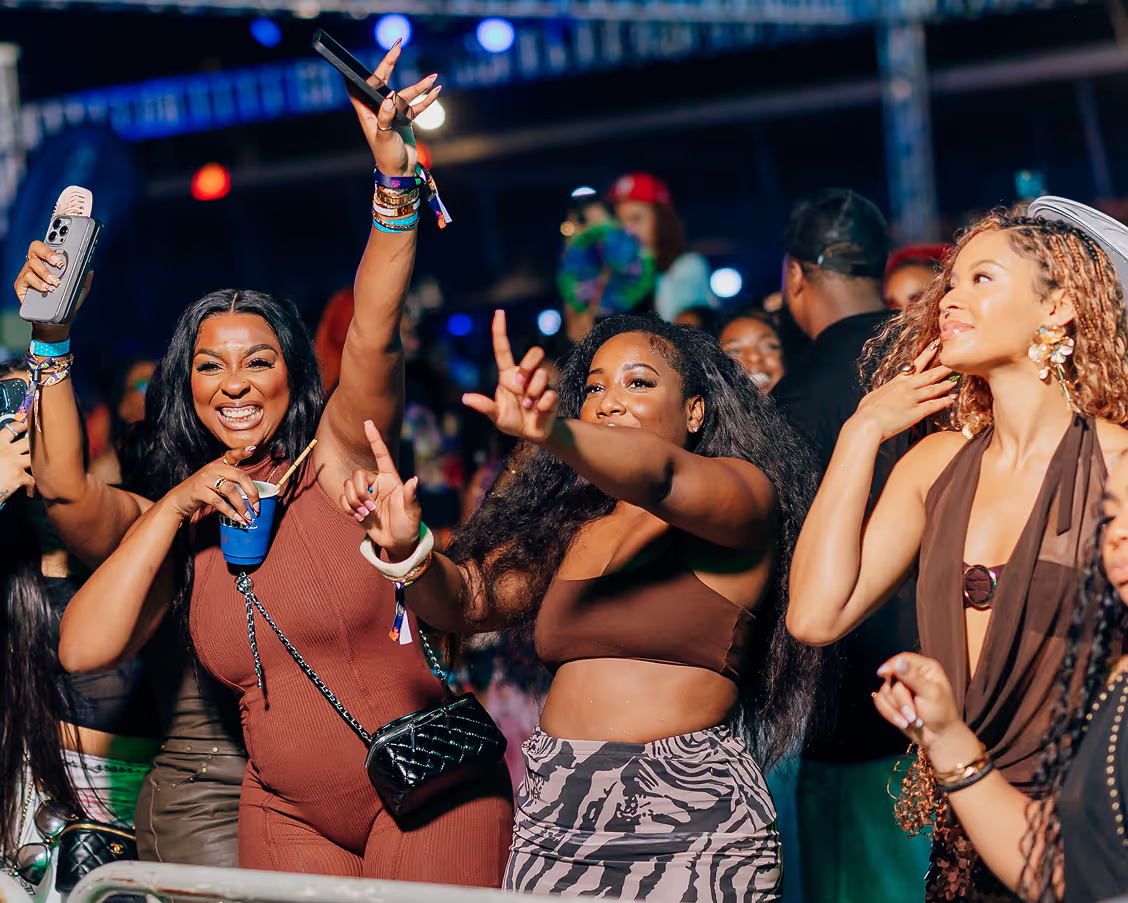
African diaspora community
The diaspora is increasingly central to what Pan-Africanism means in practice — a development that would have surprised some of its original theorists.
Holding the Tension

The generation doing the most interesting work in this space is not particularly interested in resolving the tension. They are holding it, working within it, using the cultural energy of the pan-African moment while being honest about what it is and what it is not. That honesty is itself a form of political seriousness, and it is more interesting than the alternative of either pretending the cultural moment is a political movement or dismissing it as mere branding.

"Pan-Africanism was always a project in progress. What's happening now is part of the same project. The form has changed. The aspiration hasn't."
What It Actually Means to Be Pan-African in 2026

It means something different to a Lagos-born designer building a brand in East Legon than to a British-Ghanaian musician navigating dual identity in London than to a Kenyan filmmaker making work about the Somali border. The specificity is the point. Pan-Africanism at its best has always been a conversation among differences, not an erasure of them. That conversation is louder now than it has been in decades.
Culture
Culture

Beyond the Monolith: What It Actually Means to Be Pan-African in 2026

Pan-Africanism as a political ideology has a specific history — Nkrumah, Nyerere, Marcus Garvey, the Organisation of African Unity — and it is worth knowing that history before using the term. What the word means in 2026, in the context of African streetwear brands and Afrobeats playlists and diaspora Twitter, is something substantially different from what it meant at the Bandung Conference in 1955.

Pan-African movement 2026
Pan-Africanism in 2026 is as much a cultural phenomenon as a political one — and the two are not always in agreement.
The History Worth Knowing

The political Pan-Africanism of Nkrumah and Nyerere was a specific project: continental unity as a prerequisite for decolonization, economic sovereignty, and political self-determination. It had a theory of power and a theory of change. It was serious, contentious, and ultimately only partially realized. Understanding that history matters because the cultural Pan-Africanism of 2026 is in conversation with it — whether or not the people practicing it know the conversation is happening.

Dilution or Evolution?

The question is whether the difference between political and cultural Pan-Africanism represents a dilution or an evolution. The pessimistic reading: a political project with genuine stakes has been reduced to an aesthetic and a vibe, its radical implications softened into brand identity. The optimistic reading: the cultural moment is building the affective infrastructure — the sense of shared identity and shared interest — that political Pan-Africanism always needed and rarely had.

African diaspora community
The diaspora is increasingly central to what Pan-Africanism means in practice — a development that would have surprised some of its original theorists.
Holding the Tension

The generation doing the most interesting work in this space is not particularly interested in resolving the tension. They are holding it, working within it, using the cultural energy of the pan-African moment while being honest about what it is and what it is not. That honesty is itself a form of political seriousness, and it is more interesting than the alternative of either pretending the cultural moment is a political movement or dismissing it as mere branding.

"Pan-Africanism was always a project in progress. What's happening now is part of the same project. The form has changed. The aspiration hasn't."
What It Actually Means to Be Pan-African in 2026

It means something different to a Lagos-born designer building a brand in East Legon than to a British-Ghanaian musician navigating dual identity in London than to a Kenyan filmmaker making work about the Somali border. The specificity is the point. Pan-Africanism at its best has always been a conversation among differences, not an erasure of them. That conversation is louder now than it has been in decades.

The client came to the project with a website that had grown organically over time. New pages were added as needs appeared, sections were duplicated inconsistently, and messaging became fragmented.

The challenge

As the website grew, maintaining consistency became increasingly challenging. Different pages followed different layout patterns, spacing varied across sections, and typography lost its hierarchy. Important messages were often repeated or buried, making it harder for visitors to quickly understand the offering.

Internally, the team struggled to update the site efficiently. Adding new pages required design decisions each time, slowing down iteration and increasing the risk of inconsistency. The existing setup no longer supported the pace or scale of the organization.

The approach

The solution began with a shift in mindset — from page-by-page design to system-first thinking. Truebase was used as the structural framework to redefine how content should be organized, presented, and scaled.

Core page types were identified first, followed by a clear hierarchy of content elements. Layouts were built using a consistent grid and spacing system, while typography was simplified into a scalable hierarchy that could accommodate varying content lengths. Every decision prioritized clarity and reuse.

The implementation

The website was rebuilt using modular sections that could be reused across multiple pages without visual drift. Each section followed predefined spacing and alignment rules, ensuring consistency regardless of where it appeared.

Content was restructured to highlight key information earlier and reduce unnecessary repetition. Dedicated layouts were introduced for case studies, metrics, and supporting content, improving readability and flow. The CMS was organized to support ongoing updates, allowing the team to manage content without breaking the underlying system.

After launch, the impact was immediately noticeable. The team was able to create and update pages faster, without needing design adjustments for each new piece of content. The website felt calmer, more predictable, and easier to navigate.

From a visitor perspective, the clearer structure reduced friction. Users could understand the offering more quickly, with less scrolling and fewer explanations required. The website began functioning as a reliable communication tool rather than a static presentation.

48%
Reduction in time required publish pages
32%
Increase in engagement

Heading 1

Heading 2

Heading 3

Heading 4

Heading 5
Heading 6

Lorem ipsum dolor sit amet, consectetur adipiscing elit, sed do eiusmod tempor incididunt ut labore et dolore magna aliqua. Ut enim ad minim veniam, quis nostrud exercitation ullamco laboris nisi ut aliquip ex ea commodo consequat. Duis aute irure dolor in reprehenderit in voluptate velit esse cillum dolore eu fugiat nulla pariatur.

Block quote

Ordered list

  1. Item 1
  2. Item 2
  3. Item 3

Unordered list

  • Item A
  • Item B
  • Item C

Text link

Bold text

Emphasis

Superscript

Subscript