For most of the last century, the pictures the world saw of Africa were taken by people who did not live there. A film crew would arrive, point a camera, and leave. The footage was cut in an edit suite on another continent, set to music chosen by someone else, and narrated in a voice that explained Africans to everyone but themselves.

Then something small and enormous happened. The camera turned around.

At the turn of this year, the American streamer IShowSpeed travelled through twenty African countries in about a month with his phone held out in front of him. Millions watched live. There was no script and no edit. Whatever happened in the street happened on screen. Crowds ran alongside his car. Strangers taught him dances. Markets, stadiums and neighbourhoods appeared exactly as they were on an ordinary afternoon.

IShowSpeed livestreaming with crowds during his Africa tour

The tour was a spectacle, and there is a fair argument about whether a visitor should be the one holding the phone. But it revealed something that had been true for a while. Live streaming does to the image of Africa what no documentary ever managed. It removes the editor.

An edited film makes an argument. A livestream simply shows you what is there. And what is there turns out to be far more modern, funny, crowded and alive than a century of outside footage ever suggested.

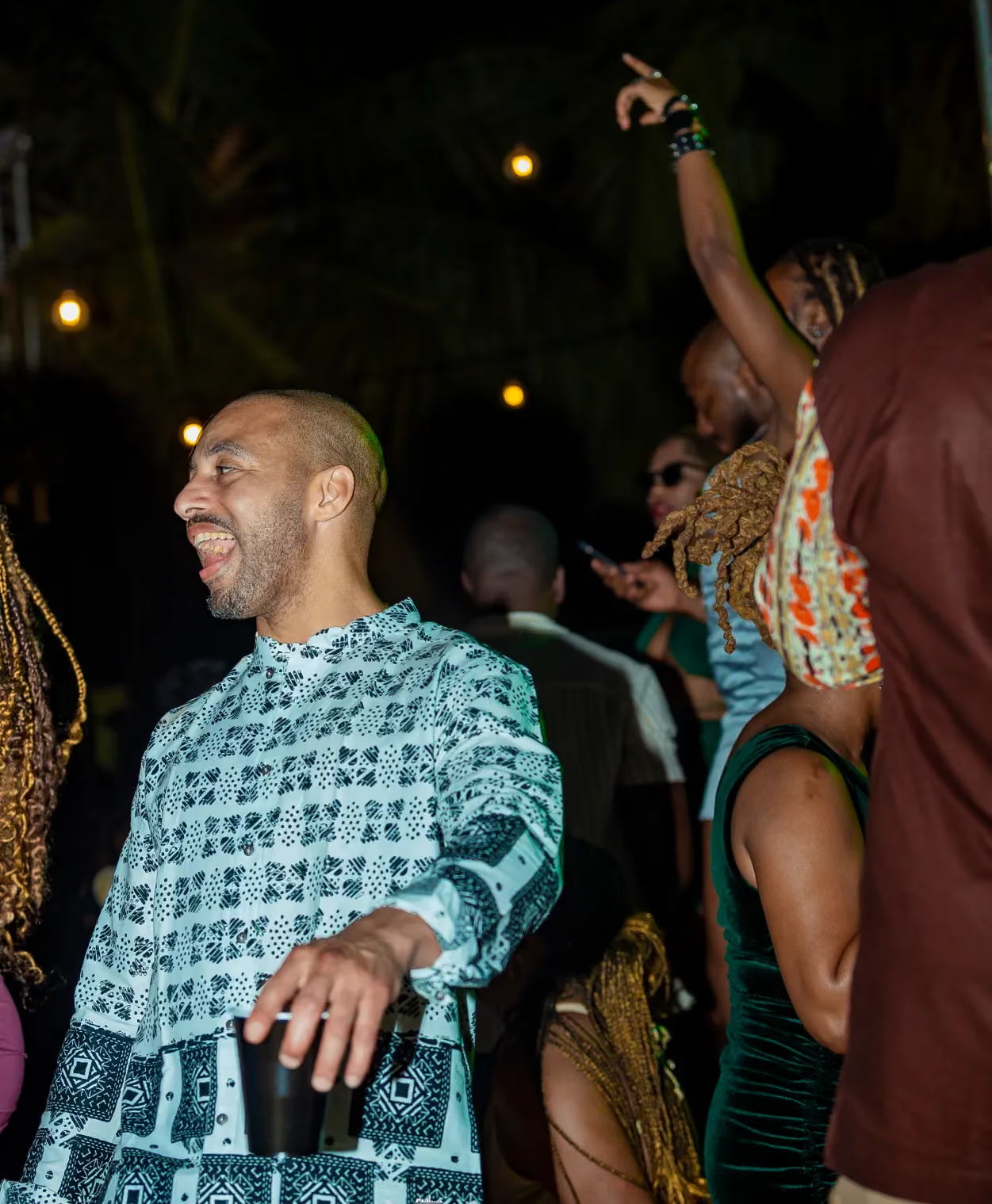
The more important story is the one happening without visitors. Across Lagos, Accra, Nairobi and Johannesburg, a generation of creators has stopped waiting to be discovered and started broadcasting. They stream for hours from bedrooms and studios. They build audiences in the hundreds of thousands. They speak in pidgin, Twi, Sheng and Zulu without translating, and the diaspora tunes in from Houston and Peckham precisely because nobody is translating.

African creator streaming from a home studio with a ring light

This changes who owns the story. A broadcaster once decided which African faces the world would see. Now a twenty-two-year-old with a ring light decides for herself, and her audience decides with her.

It also raises a harder question, and it is one Afrofuture has asked out loud. Is streaming actually good for African artists and creators, or are we pretending? The platforms are owned elsewhere. The payouts are set elsewhere. A creator in Accra can earn a fraction of what the same audience would be worth in Atlanta. Visibility is not the same thing as ownership.

Both things are true at once. The tools are borrowed, and the voice is finally ours.

The lesson for anyone building in this space is plain. Do not confuse attention with power. Attention is the opening. Power comes from what you build with it: the audience you can reach directly, the catalogue you own, the platform you are not renting.

The camera has turned around. The next task is to own the camera.
Placeholder image

For most of the last century, the pictures the world saw of Africa were taken by people who did not live there. A film crew would arrive, point a camera, and leave. The footage was cut in an edit suite on another continent, set to music chosen by someone else, and narrated in a voice that explained Africans to everyone but themselves.

Then something small and enormous happened. The camera turned around.

At the turn of this year, the American streamer IShowSpeed travelled through twenty African countries in about a month with his phone held out in front of him. Millions watched live. There was no script and no edit. Whatever happened in the street happened on screen. Crowds ran alongside his car. Strangers taught him dances. Markets, stadiums and neighbourhoods appeared exactly as they were on an ordinary afternoon.

IShowSpeed livestreaming with crowds during his Africa tour

The tour was a spectacle, and there is a fair argument about whether a visitor should be the one holding the phone. But it revealed something that had been true for a while. Live streaming does to the image of Africa what no documentary ever managed. It removes the editor.

An edited film makes an argument. A livestream simply shows you what is there. And what is there turns out to be far more modern, funny, crowded and alive than a century of outside footage ever suggested.

The more important story is the one happening without visitors. Across Lagos, Accra, Nairobi and Johannesburg, a generation of creators has stopped waiting to be discovered and started broadcasting. They stream for hours from bedrooms and studios. They build audiences in the hundreds of thousands. They speak in pidgin, Twi, Sheng and Zulu without translating, and the diaspora tunes in from Houston and Peckham precisely because nobody is translating.

African creator streaming from a home studio with a ring light

This changes who owns the story. A broadcaster once decided which African faces the world would see. Now a twenty-two-year-old with a ring light decides for herself, and her audience decides with her.

It also raises a harder question, and it is one Afrofuture has asked out loud. Is streaming actually good for African artists and creators, or are we pretending? The platforms are owned elsewhere. The payouts are set elsewhere. A creator in Accra can earn a fraction of what the same audience would be worth in Atlanta. Visibility is not the same thing as ownership.

Both things are true at once. The tools are borrowed, and the voice is finally ours.

The lesson for anyone building in this space is plain. Do not confuse attention with power. Attention is the opening. Power comes from what you build with it: the audience you can reach directly, the catalogue you own, the platform you are not renting.

The camera has turned around. The next task is to own the camera.
The client came to the project with a website that had grown organically over time. New pages were added as needs appeared, sections were duplicated inconsistently, and messaging became fragmented.

The challenge

As the website grew, maintaining consistency became increasingly challenging. Different pages followed different layout patterns, spacing varied across sections, and typography lost its hierarchy. Important messages were often repeated or buried, making it harder for visitors to quickly understand the offering.

Internally, the team struggled to update the site efficiently. Adding new pages required design decisions each time, slowing down iteration and increasing the risk of inconsistency. The existing setup no longer supported the pace or scale of the organization.

The approach

The solution began with a shift in mindset — from page-by-page design to system-first thinking. Truebase was used as the structural framework to redefine how content should be organized, presented, and scaled.

Core page types were identified first, followed by a clear hierarchy of content elements. Layouts were built using a consistent grid and spacing system, while typography was simplified into a scalable hierarchy that could accommodate varying content lengths. Every decision prioritized clarity and reuse.

The implementation

The website was rebuilt using modular sections that could be reused across multiple pages without visual drift. Each section followed predefined spacing and alignment rules, ensuring consistency regardless of where it appeared.

Content was restructured to highlight key information earlier and reduce unnecessary repetition. Dedicated layouts were introduced for case studies, metrics, and supporting content, improving readability and flow. The CMS was organized to support ongoing updates, allowing the team to manage content without breaking the underlying system.

After launch, the impact was immediately noticeable. The team was able to create and update pages faster, without needing design adjustments for each new piece of content. The website felt calmer, more predictable, and easier to navigate.

From a visitor perspective, the clearer structure reduced friction. Users could understand the offering more quickly, with less scrolling and fewer explanations required. The website began functioning as a reliable communication tool rather than a static presentation.

48%
Reduction in time required publish pages
32%
Increase in engagement

Heading 1

Heading 2

Heading 3

Heading 4

Heading 5
Heading 6

Lorem ipsum dolor sit amet, consectetur adipiscing elit, sed do eiusmod tempor incididunt ut labore et dolore magna aliqua. Ut enim ad minim veniam, quis nostrud exercitation ullamco laboris nisi ut aliquip ex ea commodo consequat. Duis aute irure dolor in reprehenderit in voluptate velit esse cillum dolore eu fugiat nulla pariatur.

Block quote

Ordered list

  1. Item 1
  2. Item 2
  3. Item 3

Unordered list

  • Item A
  • Item B
  • Item C

Text link

Bold text

Emphasis

Superscript

Subscript