In the summer of 1990, a thirty-eight-year-old striker came off the bench for Cameroon and scored. Then he did something nobody had seen at a World Cup. Roger Milla ran to the corner flag, put one hand on his stomach, raised the other in the air, and danced. He scored four goals at that tournament and danced after every one. Cameroon became the first African team to reach a quarter-final. But ask anyone what they remember, and they will not describe the goals. They will describe the hips.

Roger Milla dancing at the corner flag, Italia 90

A goal lasts a second. The celebration is what travels.

Twenty years later, in the opening match of the first World Cup on African soil, Siphiwe Tshabalala hit a shot into the top corner at Soccer City. What followed is burned into the memory of a continent. Five players lined up on the touchline and moved as one, a rehearsed routine, shoulder to shoulder, grinning. South Africa did not win the tournament. That dance won the day.

Bafana Bafana players dancing on the touchline after Tshabalala’s goal, 2010

In 2002, when Senegal beat France, the world champions, Papa Bouba Diop laid his shirt on the grass by the corner flag and his teammates danced in a circle around it. It looked like a ritual because it was one.

Something important is happening in those moments, and it has to do with who is watching. A World Cup goal is seen by hundreds of millions of people at once. For the few seconds after the ball crosses the line, the scorer owns the largest stage on earth and can say anything at all. African players have used those seconds, again and again, to say where they are from.

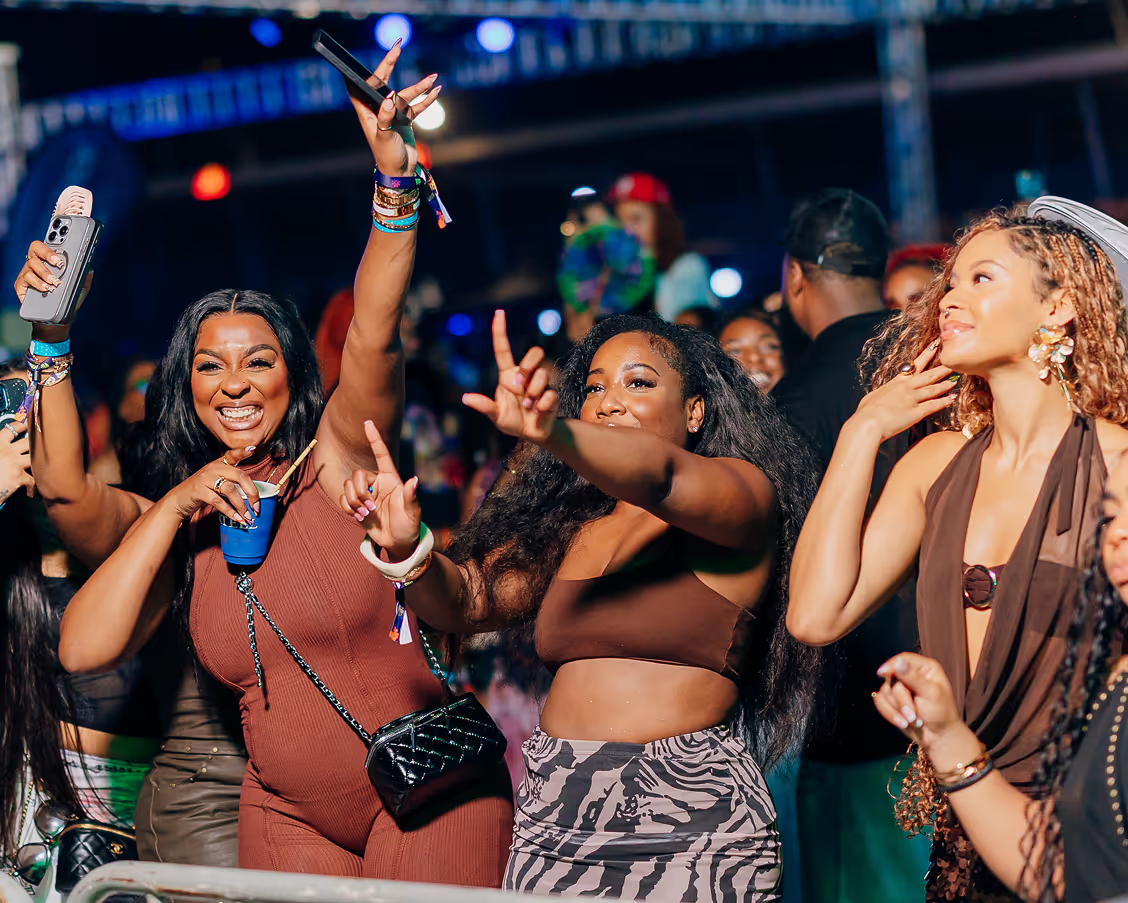
This is why the dances that take over the continent keep finding their way onto the pitch. The Gwara Gwara came out of South Africa and ended up on the Grammy stage. Zanku came out of the streets of Lagos, all sharp legwork and stamping feet. Pilolo came out of Ghana. Each began in a club, a yard or a schoolground. Each was eventually performed in front of a stadium by a player who had just scored and had ten seconds to tell the world something.

It works in the other direction too. A dance done at the corner flag on a Saturday is being copied in a playground on Monday, in a city thousands of kilometres from where it was invented. The pitch has become one of the fastest ways for African movement to travel.

Kids copying a goal celebration dance in a playground

There is a lesson in this about how culture spreads. We tend to think it moves through official channels, through labels, broadcasters and campaigns. More often it moves through joy. Nobody instructs a footballer to dance. Nobody pays for the placement. A person is simply happy, in public, in the way their home taught them to be happy.

That is harder to resist than any advertisement. You can ignore a slogan. It is very difficult to ignore a man dancing at a corner flag.

So the next time an African player scores, watch what happens after. The goal goes on the scoresheet. The celebration goes everywhere else.
Placeholder image

In the summer of 1990, a thirty-eight-year-old striker came off the bench for Cameroon and scored. Then he did something nobody had seen at a World Cup. Roger Milla ran to the corner flag, put one hand on his stomach, raised the other in the air, and danced. He scored four goals at that tournament and danced after every one. Cameroon became the first African team to reach a quarter-final. But ask anyone what they remember, and they will not describe the goals. They will describe the hips.

Roger Milla dancing at the corner flag, Italia 90

A goal lasts a second. The celebration is what travels.

Twenty years later, in the opening match of the first World Cup on African soil, Siphiwe Tshabalala hit a shot into the top corner at Soccer City. What followed is burned into the memory of a continent. Five players lined up on the touchline and moved as one, a rehearsed routine, shoulder to shoulder, grinning. South Africa did not win the tournament. That dance won the day.

Bafana Bafana players dancing on the touchline after Tshabalala’s goal, 2010

In 2002, when Senegal beat France, the world champions, Papa Bouba Diop laid his shirt on the grass by the corner flag and his teammates danced in a circle around it. It looked like a ritual because it was one.

Something important is happening in those moments, and it has to do with who is watching. A World Cup goal is seen by hundreds of millions of people at once. For the few seconds after the ball crosses the line, the scorer owns the largest stage on earth and can say anything at all. African players have used those seconds, again and again, to say where they are from.

This is why the dances that take over the continent keep finding their way onto the pitch. The Gwara Gwara came out of South Africa and ended up on the Grammy stage. Zanku came out of the streets of Lagos, all sharp legwork and stamping feet. Pilolo came out of Ghana. Each began in a club, a yard or a schoolground. Each was eventually performed in front of a stadium by a player who had just scored and had ten seconds to tell the world something.

It works in the other direction too. A dance done at the corner flag on a Saturday is being copied in a playground on Monday, in a city thousands of kilometres from where it was invented. The pitch has become one of the fastest ways for African movement to travel.

Kids copying a goal celebration dance in a playground

There is a lesson in this about how culture spreads. We tend to think it moves through official channels, through labels, broadcasters and campaigns. More often it moves through joy. Nobody instructs a footballer to dance. Nobody pays for the placement. A person is simply happy, in public, in the way their home taught them to be happy.

That is harder to resist than any advertisement. You can ignore a slogan. It is very difficult to ignore a man dancing at a corner flag.

So the next time an African player scores, watch what happens after. The goal goes on the scoresheet. The celebration goes everywhere else.

The client came to the project with a website that had grown organically over time. New pages were added as needs appeared, sections were duplicated inconsistently, and messaging became fragmented.

The challenge

As the website grew, maintaining consistency became increasingly challenging. Different pages followed different layout patterns, spacing varied across sections, and typography lost its hierarchy. Important messages were often repeated or buried, making it harder for visitors to quickly understand the offering.

Internally, the team struggled to update the site efficiently. Adding new pages required design decisions each time, slowing down iteration and increasing the risk of inconsistency. The existing setup no longer supported the pace or scale of the organization.

The approach

The solution began with a shift in mindset — from page-by-page design to system-first thinking. Truebase was used as the structural framework to redefine how content should be organized, presented, and scaled.

Core page types were identified first, followed by a clear hierarchy of content elements. Layouts were built using a consistent grid and spacing system, while typography was simplified into a scalable hierarchy that could accommodate varying content lengths. Every decision prioritized clarity and reuse.

The implementation

The website was rebuilt using modular sections that could be reused across multiple pages without visual drift. Each section followed predefined spacing and alignment rules, ensuring consistency regardless of where it appeared.

Content was restructured to highlight key information earlier and reduce unnecessary repetition. Dedicated layouts were introduced for case studies, metrics, and supporting content, improving readability and flow. The CMS was organized to support ongoing updates, allowing the team to manage content without breaking the underlying system.

After launch, the impact was immediately noticeable. The team was able to create and update pages faster, without needing design adjustments for each new piece of content. The website felt calmer, more predictable, and easier to navigate.

From a visitor perspective, the clearer structure reduced friction. Users could understand the offering more quickly, with less scrolling and fewer explanations required. The website began functioning as a reliable communication tool rather than a static presentation.

48%
Reduction in time required publish pages
32%
Increase in engagement

Heading 1

Heading 2

Heading 3

Heading 4

Heading 5
Heading 6

Lorem ipsum dolor sit amet, consectetur adipiscing elit, sed do eiusmod tempor incididunt ut labore et dolore magna aliqua. Ut enim ad minim veniam, quis nostrud exercitation ullamco laboris nisi ut aliquip ex ea commodo consequat. Duis aute irure dolor in reprehenderit in voluptate velit esse cillum dolore eu fugiat nulla pariatur.

Block quote

Ordered list

  1. Item 1
  2. Item 2
  3. Item 3

Unordered list

  • Item A
  • Item B
  • Item C

Text link

Bold text

Emphasis

Superscript

Subscript